In the world of health care, the distance between a successful recovery and a medical error often comes down to a single factor: communication. At ÀÏ˾»ú´«Ã½, the College of Health Professions is ensuring that the first time a nurse, a physical therapist and a physician assistant talk to one another isn’t over a crashing patient in a hospital ward.
Instead, they are meeting over pizza, in theater seats, and across high-tech manikins in the university’s Meinders Simulation Center. Through a series of intentional interprofessional education events, ÀÏ˾»ú´«Ã½ is breaking down the traditional "silos" of education to create a more collaborative generation of health care providers.
The art of the ‘elevator speech’
The journey begins with a program called "Interprofessional Roles and Responsibilities,� where students gather for what looks like a professional version of speed dating. After a courtyard pizza lunch, students develop "elevator speeches" — 30-second pitches that explain their specific clinical role.
“This is an introductory event where students engage for the first time with each other,� said Dr. Wendee Lentz, the coordinator of interprofessional education. “They consistently leave this event saying, ‘I didn’t know a PA could do that’ or ‘I didn’t know a PT could do that.’ It’s about building bridges among the professions before they ever step into a clinic."
Kennedy Berus, a doctor of physical therapy (DPT) student, noted the value of understanding the other roles in clinical settings.
"A lot of people think PT is just a place you go once you are hurt, but it's so much more — it’s preventative,� Berus said.
And hearing from students in other programs is equally beneficial: “It was cool to see their perspective and build connections with people I’d normally never see outside my own building."
Trading places, swapping tips
The collaboration gets hands-on through peer-to-peer teaching. In the summer, nursing students teach PT students the "tricks of the trade" for efficiency in taking vital signs. In the fall, the roles reverse with "Smooth Moves," where PT students teach nursing students the proper use of assistive devices like walkers and crutches, and ergonomic techniques associated with moving and transferring patients.
"My group was teaching bed mobility and how to move patients safely and with the proper positioning," Berus explained. "It’s about brushing up on the specifics to make sure we're teaching them the right way, by the book."
"At first, my nursing students were nervous. They tried to back out!" quipped Dr. Janice James, director of the Meinders Simulation Center. "But afterward, their confidence skyrocketed. They realized that if they could teach a peer, they could teach a patient."
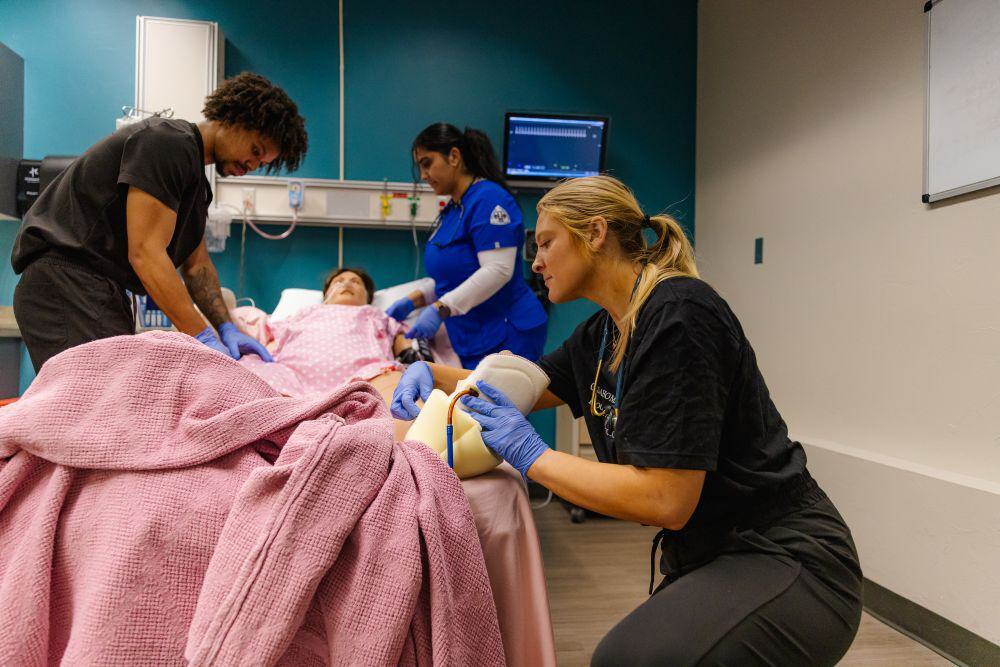
The emotional and technical training culminates in the labs in the Meinders Simulation Center. In the latest session in late January, students were assigned to a room with a simulated motorcycle accident victim. As the PT and nursing students worked to mobilize the patient, the manikin began to "decompensate," meaning its vitals drop and the situation turns critical.
Nursing students Chloi Thurman and Teagen Lindgren found the crossover invaluable before entering the workforce.
"PT sometimes is their own thing and we do our own thing in the hospital," Lindgren said. "It was interesting to see what it would be like if we were in the room at the same time and something unexpected happened."
Ashley Johnson, a doctor of nursing practice (DNP) student, played the role of the provider called in when the patient’s condition started to deteriorate.
"She [the professor] intends to make it nerve-wracking," Johnson said. "Nurses are calling us saying the patient is short of breath all of a sudden. You have to critically think quickly. If this were a real patient, we can’t go into another room and look stuff up; we need to fix them right away."
Despite the pressure, the students learn to stay within their roles. They were able to use teamwork and communication to improve on their patient outcomes, which is one of the main goals of interprofessional education.
"I didn't feel a sense of hierarchy," Johnson noted. "In an actual hospital, we need information from the nurses. It’s all teamwork."
"We don't focus on what they did wrong in a punitive way," James said. "We focus on the thinking behind the actions. It’s a safe environment to realize that health care is a team effort."
From stage to clinic
The program also bridges medicine and the arts. DPT students work with students in the Ann Lacy School of American Dance and Entertainment throughout the year on injury risk reduction efforts and physical therapy interventions on injuries.
And every January, School of Theatre students perform a dramatic reading of the Pulitzer Prize-winning play “W;t,� which follows the final hours of an English professor with stage-four cancer.
The performance, attended by more than 200 College of Health Professions students, is followed by a faculty-led interprofessional discussion with small groups of students, then a "talkback" session with the playwright herself, Maggie Edson.
"It hits empathy and sympathy," Lentz explained. "It’s a research-based hospital setting in the play, so we discuss the values and ethics of how the medical staff communicates with the patient. It is truly one of the best events our students participate in."
"At first, people were like, ‘Oh, I have to go to this thing,’" nursing major Lindgren confessed. "But once it started, it was so beneficial. I remember thinking, ‘I hope I can be the kind of nurse that cares so deeply for my patients.’"
Practice makes patient: From simulation to shared respect
For prospective students, the message from those finishing a College of Health Professions program is clear: don't be afraid of the "fake" patient or the watchful eyes of professors.
"I’m always nervous for sims," Thurman said. "But your professors want you to succeed. No one is judging you; they just want you to know how to do things now so when you go into the real world, you’re prepared."
By the time the students graduate, the traditional barriers between disciplines are replaced by mutual respect. As Berus put it, "We all know that we need each other for the greater good of taking care of our patients."
James agreed, adding: "They learn those soft skills you can't teach in a classroom, like how to talk to each other, what information the other person needs, and how to lean on each other when things get tough."
